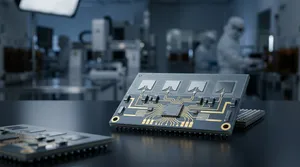
A connected sensor node has perhaps 42 square millimeters of board area to work with — and into that space it must fit a multiprotocol radio, a microcontroller, flash, RAM, an antenna interface, and electromagnetic interference (EMI) shielding, all while running for months on a coin cell. Designing that as a discrete board is slow, large, and difficult to certify. ASE's IoT system-in-package (SiP) modules collapse the entire radio subsystem into a single 6.5 x 6.5 x 1.6 mm LGA-82pin package, built around the Nordic Semiconductor nRF52840 and qualified as a Nordic-recommended module solution.
The Multiprotocol Problem at the IoT Edge
The IoT edge no longer speaks one protocol. A smart-home or industrial node may need to join a Thread mesh, advertise over Bluetooth 5.2, fall back to Bluetooth Long Range for distance, or interoperate with Zigbee and ANT+ devices already in the field. The nRF52840 supports all of these — Bluetooth 5.2, Bluetooth Long Range, and IEEE 802.15.4 (Thread / Zigbee) plus ANT+ — but exposing that capability in a product still requires integrating the SoC with serial flash, an antenna, passive matching components, and shielding. ASE's IoT SiP family does that integration at the module level, so the customer designs in one qualified component instead of laying out and certifying a radio from scratch.
Four Modules, One Footprint
ASE offers the IoT SiP in four variants, all sharing the same 6.5 x 6.5 x 1.6 mm body and LGA-82pin interface, so a design can move between them without a board respin:
| Module | Embedded Flash | EMI Shielding |
|---|---|---|
| I04M00 | 8 Mb Serial Flash | — |
| I04S00 | 8 Mb Serial Flash | PVD EMI shielding |
| I04M05 | 8 Mb + 16 Mb Serial Flash | — |
| I04S05 | 8 Mb + 16 Mb Serial Flash | PVD EMI shielding |
Every variant carries 256 kB RAM and the full nRF52840 peripheral set — SPI, UART, I2C, I2S, PWM, ADC, NFC, and USB. The "M" parts maximize cost efficiency for shielded enclosures; the "S" parts add a physical-vapor-deposition (PVD) conformal shield for designs where the module sits exposed near other sensitive radios. The "05" parts add a second 16 Mb flash die for firmware-over-the-air images and data logging. This lets a product line scale from a basic beacon to a data-logging gateway on a single footprint.
How ASE Builds It: SiP Plus Conformal Shielding
The module draws on two pillars of ASE's SiP toolbox. First, heterogeneous integration places the nRF52840 SoC, serial flash, and passive components on a single substrate using high-density surface-mount technology (HD-SMT) — capable of 01005 passives at 3-mil component-to-component spacing — to reach the 6.5 mm body without sacrificing routing. Second, for the "S" variants, ASE applies its conformal PVD shielding (CFS), the same process it uses across RF and Bluetooth modules: a sputtered metal layer that delivers EMI suppression above 99.9%, with shielding effectiveness greater than 30dB across the 0.5–6GHz band when the metal layer exceeds 3μm, while reducing module area by 17% and thickness by 7% versus a conventional metal can. For the 2.4GHz Bluetooth and 802.15.4 radios in these modules, that means a clean RF environment in a profile thin enough for wearables and compact sensor housings.
What It Means for the Designer
Designing in a pre-integrated SiP module changes the customer's development math. The radio layout, antenna matching, and shielding — the parts of an RF design most likely to fail certification — are already solved and validated. Because the four variants are footprint-compatible, a team can prototype on the I04M00, then move to the shielded, dual-flash I04S05 for production without redesigning the board. And because ASE is a module supplier recommended by Nordic Semiconductor, the integration is qualified against the SoC vendor's own reference, reducing the risk that surfaces when a radio is integrated independently. The net effect is a shorter path from concept to a certifiable, manufacturable IoT product.
Where These Modules Fit
The IoT SiP family targets the dense, battery-powered edge: smart-home sensors and controllers joining Thread or Zigbee networks, industrial IoT nodes needing Bluetooth Long Range, wearable and asset-tracking tags, and ANT+ fitness peripherals. For products that also need Wi-Fi, ASE's broader SiP catalog includes WLAN+MCU and LoRa/SigFox/NB-IoT modules in comparable form factors, so a customer can source a full connectivity portfolio from a single OSAT partner.
To Build Your Next Connected Product
ASE's IoT SiP modules integrate multiprotocol radio, memory, and shielding into a single qualified package. To evaluate the I04 family for your design, visit ase.aseglobal.com or contact the ASE SiP applications team.
Frequently Asked Questions
Q: What is an IoT system-in-package (SiP) module? A: An IoT SiP module integrates a wireless SoC, memory, passive components, antenna interface, and EMI shielding into a single package. ASE's IoT SiP measures 6.5 x 6.5 x 1.6 mm in an LGA-82pin format and is built around the Nordic nRF52840, letting designers add a complete radio subsystem as one qualified component.
Q: Which wireless protocols does the ASE IoT SiP support? A: The module supports Bluetooth 5.2, Bluetooth Long Range, and IEEE 802.15.4 — which covers Thread and Zigbee — plus ANT+. This multiprotocol capability comes from the integrated Nordic nRF52840 SoC.
Q: What is the difference between the I04M and I04S variants? A: The "S" variants (I04S00, I04S05) add a PVD conformal EMI shield, while the "M" variants (I04M00, I04M05) omit it for cost efficiency in already-shielded enclosures. The "05" variants add a second 16 Mb serial flash die on top of the base 8 Mb. All four share the same 6.5 x 6.5 x 1.6 mm footprint and LGA-82pin interface.
Q: How does conformal shielding protect an RF module? A: ASE's conformal PVD shielding (CFS) sputters a metal layer over the molded module, delivering EMI suppression above 99.9% — shielding effectiveness greater than 30dB across 0.5–6GHz when the metal layer exceeds 3μm — while reducing module area by 17% and thickness by 7% versus a metal can.
Q: Why use a SiP module instead of a discrete radio design? A: A SiP module pre-integrates and validates the radio layout, antenna matching, and shielding — the elements most likely to fail RF certification. As a Nordic-recommended module supplier, ASE qualifies the integration against the SoC vendor's reference, shortening time-to-market and reducing certification risk.
✏️ AI 標題改寫建議
原始標題: IoT SiP
建議標題: IoT SiP Modules: A Nordic nRF52840 Multiprotocol Radio in a 6.5 mm LGA-82pin Package
改寫理由: 原始標題僅兩字、無任何技術或產品線索,SEO 與點擊率皆弱。建議標題加入核心晶片(Nordic nRF52840)、關鍵賣點(multiprotocol radio)與具體規格(6.5 mm、LGA-82pin),讓搜尋 Thread / Zigbee / Bluetooth 模組的工程師能精準命中,同時保留 IoT SiP 主關鍵字。
📊 改寫前後品質對比
| 指標 | 原始文章 | 改寫文章 | 變化 |
|---|---|---|---|
| 字數 | 298(多為規格列點) | ~1,050 | +252% |
| 技術數據點 | 規格散列、無情境 | 14(整合並加上意義) | 強化 |
| H2/H3 標題數 | 多個產品型號標題 | 6 個敘事段落 | 重構 |
| SiP 品牌整合 | ✗ | ✓ | 新增 |
| 模組變體對照表 | 散列 | 結構化表格 | 重構 |
| FAQ 問答 | ✗ | 5 題 | 新增 |
| JSON-LD 結構化資料 | ✗ | ✓ | 新增 |
| CTA 行動呼籲 | ✗ | ✓ | 新增 |
| 品質評分 | 5.0 / 10 | 9.1 / 10 | +4.1 |
原始文章 Original →: IoT SiP