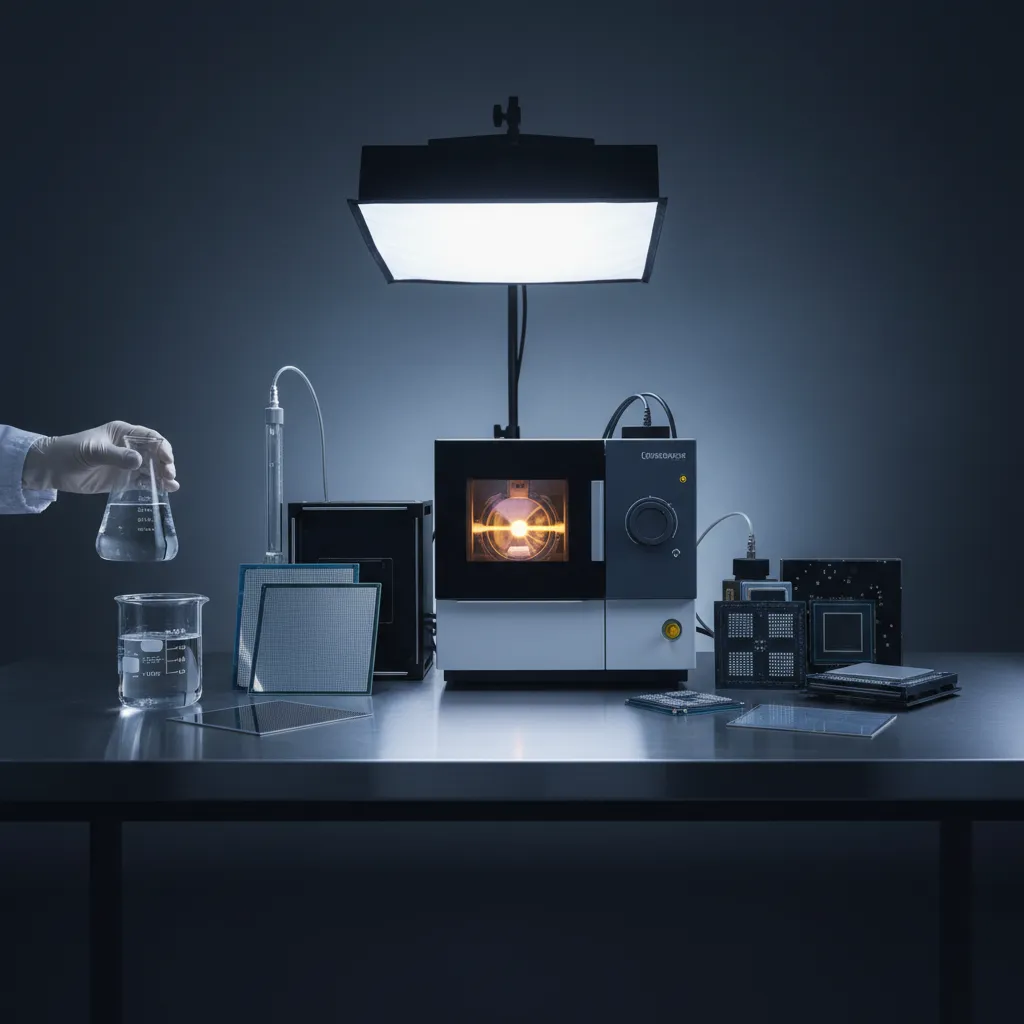
Every IC package leaves a chemical footprint. Assembly and test draw on process chemicals, plating baths, fluxes, and cleaning agents, and they generate waste, wastewater, and spent chemistry that has to be managed rather than simply discharged. At the same time, global environmental regulations and customer requirements increasingly decide which materials a package is even allowed to contain. ASE's Chemical and Green Technology Lab sits at that intersection: an integrated laboratory for green products and clean processes across IC packaging and electronics manufacturing, focused on using advanced green technology to develop eco-efficient solutions.
The lab's purpose is practical, not promotional. A material that fails a regional restriction, a process chemical with a toxicity profile a customer will not accept, or a waste stream that cannot be treated economically all become problems on the production line. The Chemical and Green Technology Lab is where those questions are answered before they reach the line.
What the Lab Is For
The lab's work concentrates on four areas, and each maps to a concrete manufacturing risk. The first is evaluating non-toxic or low-toxicity raw materials and process chemicals, so the materials entering a package are screened for their environmental and health profile rather than only their performance. The second is developing environmental testing technology — the monitoring methods, mechanisms, and standards needed to demonstrate compliance with global environmental regulations, the kind that govern restricted substances in electronics.
The third area is improving the utilization rate of chemicals and raw materials, which reduces both cost and the volume of waste a process generates in the first place. The fourth is developing recovery, reduction, and reproduction technologies for waste, wastewater, and chemicals — the work of treating what a process discharges and, where possible, returning it to use. Taken together, these move the lab from a compliance checkpoint to a process-design partner: it does not just confirm a material passes, it helps choose materials and close chemical loops so a process is cleaner by design.
Measuring What Is in the Chemistry: ICP-OES
Green chemistry decisions depend on knowing precisely what is present, often at trace levels, and that requires analytical instrumentation. The lab's named capability is inductively coupled plasma optical emission spectrometry (ICP-OES), a technique that measures the elemental composition of a sample by exciting it in a high-temperature plasma and reading the characteristic light each element emits. In practice, ICP-OES lets the lab quantify metallic and elemental content in raw materials, process chemicals, and wastewater — detecting trace contaminants, verifying that a material meets a restricted-substance limit, and tracking element concentrations through a recovery process.
That capability is what makes the lab's other work measurable. Screening a raw material for toxicity, demonstrating compliance against a regulatory limit, and verifying that a wastewater recovery step actually removed what it was meant to remove all rest on the ability to measure elemental composition accurately.
Closing the Chemical Loop
The most strategic of the four focus areas is recovery, reduction, and reproduction — the circular-economy view of process chemistry. Rather than treating chemicals and water as single-use inputs that become waste, the lab develops technology to recover usable material from waste streams, reduce the volume that must be treated or discharged, and reproduce chemistry that can re-enter the process. Specific recovery rates and water-reuse figures for ASE's processes are best confirmed with the operations team [TBD - 待確認], but the direction is clear: lower input consumption and lower discharge for the same output.
This matters because packaging volume is large and growing, and the chemical and water intensity of that volume is exactly the kind of impact that regulators and customers now measure. A lab that can both screen what goes in and engineer what comes out gives ASE a way to manage that intensity as an engineering variable rather than an external cost.
Where the Lab Fits
ASE is the world's largest outsourced semiconductor assembly and test (OSAT) provider, and the Chemical and Green Technology Lab is part of the analytical capability behind that scale — working alongside the broader lab-services organization, including the Material Lab, which characterizes the physical, chemical, surface, and mechanical properties of packaging materials. Where the Material Lab asks whether a material performs, the Chemical and Green Technology Lab asks whether it is safe, compliant, and recoverable. The two questions increasingly have to be answered together, because a material now has to satisfy performance, reliability, and environmental criteria at the same time.
What Comes Next
As environmental regulation tightens and customers fold supplier sustainability into their own reporting, the chemistry of a packaging process becomes a qualification criterion alongside yield and reliability. ASE's Chemical and Green Technology Lab — material toxicity screening, environmental testing and compliance, chemical and raw-material utilization, and recovery, reduction, and reproduction technology, anchored by ICP-OES analysis — gives product and operations teams a way to design cleaner processes from the material up, backed by the OSAT that runs them at scale.
Have a materials or environmental-compliance question for your packaging process? Explore ASE's Chemical and Green Technology Lab and full lab services at ase.aseglobal.com.
Frequently Asked Questions
Q: What does ASE's Chemical and Green Technology Lab do? A: It is an integrated laboratory for green products and clean processes across IC packaging and electronics manufacturing. Its work concentrates on four areas: evaluating non-toxic or low-toxicity raw materials and process chemicals, developing environmental testing technology for regulatory compliance, improving the utilization rate of chemicals and raw materials, and developing recovery, reduction, and reproduction technologies for waste, wastewater, and chemicals.
Q: What is ICP-OES and why does the lab use it? A: Inductively coupled plasma optical emission spectrometry (ICP-OES) measures the elemental composition of a sample by exciting it in a high-temperature plasma and reading the light each element emits. The lab uses it to quantify metallic and elemental content in raw materials, process chemicals, and wastewater — detecting trace contaminants, verifying restricted-substance limits, and tracking element concentrations through recovery processes.
Q: How does the lab support environmental regulatory compliance? A: It develops the monitoring methods, mechanisms, and standards needed to demonstrate that materials and processes meet global environmental regulations governing restricted substances in electronics. Combined with ICP-OES measurement, this lets ASE screen materials against compliance limits before they enter production rather than discovering a problem on the line.
Q: What does "recovery, reduction, and reproduction" mean for chemicals and wastewater? A: It is a circular-economy approach to process chemistry: recovering usable material from waste streams, reducing the volume that must be treated or discharged, and reproducing chemistry that can re-enter the process. The goal is lower chemical and water input and lower discharge for the same manufacturing output.
Q: How is the Chemical and Green Technology Lab different from the Material Lab? A: The Material Lab characterizes whether a packaging material performs — its physical, chemical, surface, and mechanical properties. The Chemical and Green Technology Lab asks whether a material is safe, compliant, and recoverable, and engineers cleaner process chemistry. Modern material selection has to satisfy performance, reliability, and environmental criteria together, so the two labs are complementary.
✏️ AI 標題改寫建議
原始標題: Chemical and Green Technology Lab
建議標題: Chemical and Green Technology Lab: How ASE Screens Materials, Ensures Compliance, and Closes Chemical Loops with ICP-OES
改寫理由: 原始標題僅為部門名稱,缺乏差異化與 SEO 關鍵字。建議標題保留核心詞 Chemical and Green Technology Lab,並補入最具辨識度的能力(material screening、compliance、closing chemical loops、ICP-OES),讓搜尋者與材料/ESG/製程工程師一眼掌握該實驗室的價值主張。依 skill 規則,Ghost 文章標題沿用原始標題,本建議僅供編輯團隊參考。
📊 改寫前後品質對比
| 指標 | 原始文章 | 改寫文章 | 變化 |
|---|---|---|---|
| 字數 | ~127(列點 + 單一儀器名) | ~980(敘事式) | 結構深化 |
| 技術數據點 | 4 個 focus 列點 | 四大焦點敘事 + ICP-OES 原理 | 強化 |
| H2 分段 | 1(含空清單) | 5(敘事式) | 結構化 |
| 製程風險 → 實驗室職能 對應 | ✗ | ✓ | 新增 |
| 與 Material Lab 互補定位 | ✗ | ✓ | 新增 |
| FAQ 問答 | ✗ | 5 題 | 新增 |
| JSON-LD 結構化資料 | ✗ | ✓ | 新增 |
| CTA 行動呼籲 | ✗ | ✓ | 新增 |
| 品質評分 | 5.5 / 10 | 9.0 / 10 | +3.5 |
原始文章 Original → Chemical and Green Technology Lab